
Around 90 participants from 24 countries gathered at the Festspielhaus St. Pölten to inform themselves out about current issues in the member countries, discuss them and exchange ideas and experiences. The event was organized in cooperation with KOMU (Conference of Austrian Music School Associations) and the host MKM (Music & Art School Management Lower Austria).
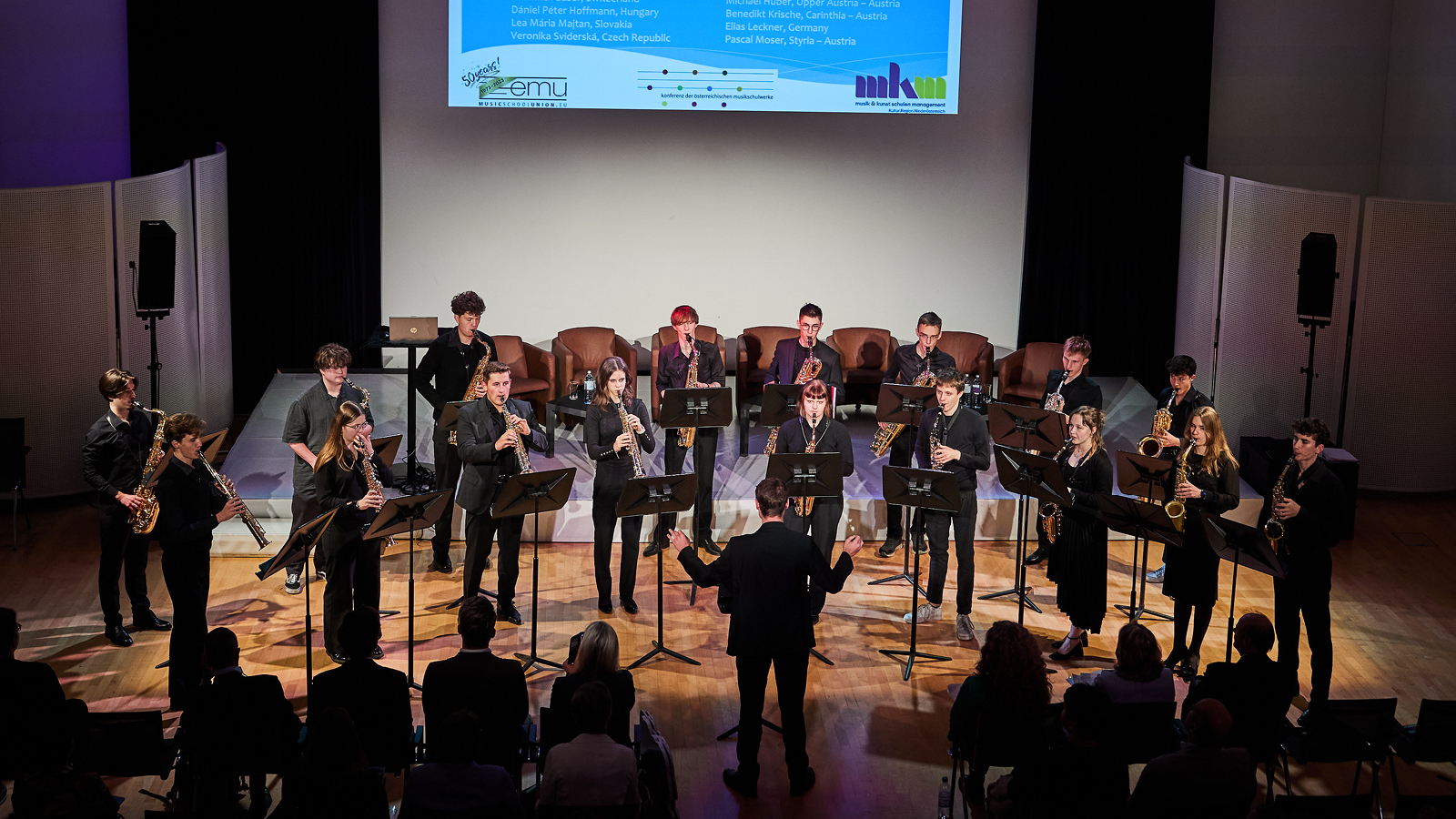
The participants were welcomed by a special youth music project: the KOMU & Friends Saxophone Orchestra conducted by Phillip Haider from Upper Austria. Seventeen young musicians from nine countries, delegated by the Austrian provinces and neighboring countries for this extraordinary project, greeted the participants with music by Gerald Preinfalk, Gina Gillie, Astor Piazzolla and others.
The European Music School Forum was officially opened by Philippe Dalarun, EMU president from 2018 to 2024, who emphasized the relevance of music education for society and thanked KOMU and in particular the host Tamara Ofenauer-Haas for the excellent collaboration, the invitation and organization of the forum. Tamara Ofenauer-Haas, managing director of the MKM Music & Art School Management Lower Austria, gave a short summary of the development of the Lower Austrian music school system and wished all participants a pleasant stay and an exciting exchange. Florian Krumpöck, member of the Austrian State Parliament officially welcomed the participants on behalf of Governor Johanna Mikl-Leitner to Lower Austria, whose cultural strategy focuses strongly on regional culture alongside international flagships such as Grafenegg and whose strong commitment to the musical and artistic education of children and young people is lived in good partnership with the municipalities and parents.
The two central topics were each opened by a keynote speaker. Adriana Di Lorenzo Tillborg presented her keynote “Arts – a strategy for music schools? Inspiration from the Swedish system” in a creative narrative of the history of kulturskoler in Sweden and her own biography. She emphasized the role of young people in the further development of music and art schools and illustrated the case of KulturCrew (in Norway, Sweden and Denmark), an initiative which gives young people the opportunity and the means to design and organize a regional cultural program in their municipality. Following her keynote speech, Adriana Di Lorenzo Tillborg was joined by two student representatives and two institutional representatives in a plenary discussion. Violetta Sebestyen and Markus Hahn, both music school students, presented the results of a student voice workshop with the young musicians of the saxophone orchestra. This workshop was part of the ongoing process started at the European Music School Symposium in October to increase the inclusion and visibility of young people’s voices within EMU. Both music school students reported on the insights the group gained from the exchange with each other about how different the music school systems are in the European countries. They expressed a strong need to collaborate with other students and even teachers, to strengthen the sense of community within the music schools. They noted that students felt strongly that music education has intrinsic benefits and should have no barriers, meaning that everyone should be able to participate regardless of their circumstances. In particular, cost should not be the decisive factor. However, they also found that students are still dependent on their parents and teachers for ongoing participation. Finally, they emphasized the importance of accommodating the different needs of students: Music schools should be required to create and promote meaningful pathways for both students who want to pursue a professional career and students who are more interested in music as a hobby.
The subsequent discussion with Dorothy Conaghan (IMC) and Asbjørn Keiding (MusiQuE and PEARLE) was moderated by Michaela Hahn and Robert Vroegindeweij and developed into a discussion about parents and families where parents have no musical background and what this means for music schools. Conaghan emphasized the role of music schools in promoting music education for all children and young people and their role in providing access to music education through qualified teachers and partnerships with schools. Regarding the relevance of music schools in society Keiding highlighted the need to engage and connect with the community in which music schools operate and emphasized the importance of relationships as the foundation of music education and society in general. After the opening session and a coffee break, Romain Asselborn, Vice President of EMU, introduced the highly moving film Nocturno, from Rudi De Bouw and Isabel Rivero Vila and photography from Eric Devillet about an ageing pianist and the crucial role of music in a phase of illness, pain and dispiritedness.
The participants then took part in the EMU-Café, where projects and initiatives from Austria, Czech Republic, Finland, France, Germany, Luxembourg, Netherlands, Norway, Sweden, Switzerland were presented and discussed. [see poster documentation] There was also information about the next European Youth Music festival in Catalonia and the Five Music Rights of the International Music Council.
After inspiring discussions and exchanges, the participants attended a Music & Arts Special concert of the Lower Austrian Music & Arts School Management as part of the European Music School Forum, featuring the Lower Austrian Jazz Orchestra, theatre and dance students from the Lower Austrian Music Schools and the KOMU & Friends Saxophone Orchestra.
On Saturday morning the European Music School Forum continued with a with a keynote speech by Natalia Ardila-Mantilla that significantly expanded the understanding of qualities in music education and emphasized the wide range of roles that music plays in people’s lives: “Qualities for shifting landscapes? Reflections on frameworks for high-quality music education in a rapidly changing society” was presented in a video followed by an online Q&A session. After this broad overview Helena Maffli, former president of EMU (2011 to 2018), drew the audience’s attention to the 10th anniversary of MusiQuE – Quality Enhancement in Music Education and the upcoming revision of the Pre-College Standards. This was followed by a presentation by Philippe Kruettli, VMS Switzerland, on Quarte Open Label as an example of a quality management system for music schools.
In the following working groups, which were hosted by EMU board members, three questions were discussed, and the results presented. The questions revolved around how health and well-being, digital issues, student’s roles in the decision making and engagement with the social context are currently reflected in music schools in the member countries and whether there is an ongoing discussion regarding the quality standards. And what EMU and MusiQuE could do to support the member countries in their quality enhancement. The lively discussions led to a variety of ideas and conclusions in the respective working groups. The need for a definition and standards for ‘good music school education’ was widely discussed and some possibilities were developed, including working on standards or a mission statement as a central shared vision, which could be based on and build upon a high quality of music and arts education and teachers. It was also discussed that new issues as digital tools, health and well-being, student’s voices and the connection to the music school’s community need to be integrated and implemented in quality development in order to enhance access and equal opportunities to music school education. The social function and artistic goals, in respect of the needs of individual students and with regard to society in general, need be constantly renegotiated by all countries and their music
schools in relation to the local and regional environment – taking into account the unique situation of each school and its different contexts and frameworks, such as urban music schools and music schools in rural regions, different music and artistic traditions, differing legal, social, and financial regulations and much more. The sharing of good practices and tools and discussions on quality standards could be supported by the EMU and MusiQuE by creating opportunities for an exchange of information and experiences.
Michaela Hahn, president of the EMU, closed the European Music School Forum and thanked all speakers, presenters, translators, and participants for sharing their knowledge and experience with each other, thereby creating connections and building relationships that will strengthen European music school education for the future.
EVENT DETAILS
EMU European Music School Forum 2024
31 May – 1 June 2024
St. Pölten, Austria
Partners:
KOMU (Conference of Austrian Music School Associations)
MKM (Music & Art School Management Lower Austria)
Documents:
Presentations
Posters from the World Café
Photo Galleries:
Thursday 30 May 2024 – St. Pölten (c) Franz Gleiss
EMU GA (31.5.2024) (c) Franz Gleiss
Special Concert Lower Austrian Music & Art Schools and Reception (c) Franz Gleiss
Friday 31 May European Music School Forum – no (c)


